
Work Package 2 (WP2) established the scientific and pedagogical foundation of the DataScEd4CiEn project through the development of the Data Inquiry for Civic Engagement in STEAM (DICE) Conceptual Framework. Designed for learners aged 9–15, the framework provides a coherent model for integrating Data Science into STEAM education while fostering data literacy, critical thinking, civic engagement, and social justice.
Developed through an extensive review of international research and an iterative design process involving all project partners, the framework identifies the key competencies, pedagogical principles, and data science practices needed to support meaningful, problem-driven learning using authentic data. It also provides practical guidance for teachers to integrate Data Science into interdisciplinary STEAM contexts.
As the theoretical backbone of the project, the DICE Framework informed the design of the Professional Development Programme (WP3), the development of the STEAM learning scenarios (WP4), and their implementation and evaluation across partner schools. By positioning Data Science at the intersection of STEAM education, civic engagement and social justice, the framework provides a coherent educational model that supports responsible citizenship and evidence-based decision-making.
Key achievements:
- Developed the DataScEd4CiEn DICE Conceptual Framework.
- Defined the core competencies and data science practices for learners aged 9–15.
- Established the pedagogical foundation for the project’s Professional Development Programme and STEAM learning scenarios.
- Integrated Data Science, STEAM Education, Civic Engagement and Social Justice into a coherent educational model.
What WP2 Delivers
WP2 produced a comprehensive set of research-based resources that provide the foundation for integrating Data Science into STEAM education:
📌 The DICE Conceptual Framework, defining the key principles, competencies and pedagogical approaches for teaching Data Science through authentic, interdisciplinary learning.
📌 A comprehensive research report, synthesising international literature and existing educational frameworks to establish a robust theoretical foundation for Data Science education in STEAM.
📌 A competency framework describing the knowledge, skills and dispositions that learners aged 9–15 need to develop data literacy, critical thinking, ethical reasoning and civic engagement.
📌 Teacher guidelines and professional development resources, supporting educators in implementing Data Science through inquiry-based, real-world STEAM learning.
📌 A pedagogical foundation that informed the development of the project’s Professional Development Programme (WP3) and interdisciplinary STEAM learning scenarios (WP4).
Together, these outputs establish a coherent educational model that enables teachers to integrate Data Science into everyday classroom practice while empowering students to investigate real-world challenges, make evidence-based decisions, and become active, informed citizens.
the DataScEd4CiEn (DICE) Framework
In an increasingly data-driven world, the ability to collect, analyse, interpret and communicate data has become an essential competency for informed decision-making, problem-solving and active citizenship. The Data Inquiry for Civic Engagement in STEAM (DICE) Conceptual Framework was developed through the DataScEd4CiEn project to support the meaningful integration of Data Science into STEAM education for learners aged 9–15.
The framework provides a research-based model that combines Data Science, STEAM Education, Civic Engagement and Social Justice, enabling students to investigate authentic real-world challenges using data. By working with real datasets, students develop data literacy, statistical reasoning, computational thinking, critical thinking and ethical decision-making while learning to use evidence to understand and address issues affecting their communities.
Designed for teachers as well as learners, the framework offers practical guidance for creating interdisciplinary, inquiry-based learning experiences that connect classroom learning with real-world contexts and responsible citizenship.
Why Data Science in STEAM Education?
The rapid growth of data in every aspect of society has transformed the way we learn, work and make decisions. From climate change and public health to artificial intelligence and social media, data shapes our understanding of the world. However, simply having access to information is not enough. Young people must also develop the ability to question, analyse, interpret and communicate data critically and responsibly.
The DICE Conceptual Framework addresses this need by integrating Data Science within STEAM education through authentic, interdisciplinary learning experiences. By investigating real-world issues using data, students develop the knowledge, skills and ethical awareness needed to become informed, responsible and active citizens.
The framework supports students in becoming:
✔️ Critical Thinkers – analysing, interpreting and evaluating data to make evidence-based decisions.
✔️ Problem Solvers – applying data science practices to investigate authentic societal and environmental challenges.
✔️ Responsible Digital Citizens – understanding the ethical use of data, artificial intelligence and digital technologies.
✔️ Active Citizens – using data to explore issues related to sustainability, social justice and civic engagement, and to propose informed solutions.
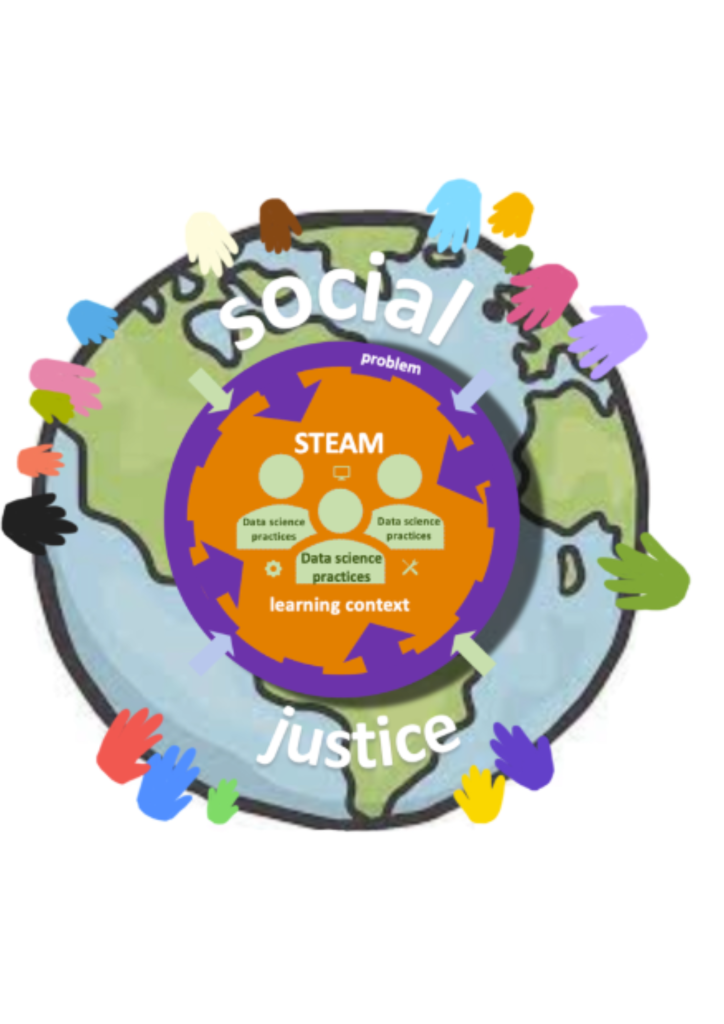
Key Components of the DataScEd4CiEn Framework
The DICE (Data Inquiry for Civic Engagement in STEAM) Conceptual Framework brings together four interconnected dimensions that support meaningful, interdisciplinary learning through Data Science.
📊 1. Data Science Practices
Students learn to work with authentic data by asking meaningful questions, collecting and cleaning data, analysing patterns, interpreting evidence, and communicating findings responsibly.
Key learning areas include:
✔ Data collection and preparation
✔ Exploratory data analysis
✔ Statistical and mathematical reasoning
✔ Data visualisation
✔ Computational thinking and digital tools
✔ Ethical use of data and Artificial Intelligence
🔬 2. STEAM Learning
Data Science is embedded within interdisciplinary STEAM learning, allowing students to investigate authentic problems that connect science, technology, engineering, the arts and mathematics.
Students engage in:
✔ Inquiry-based learning
✔ Project-based investigations
✔ Collaborative problem-solving
✔ Real-world data analysis
✔ Creative design and innovation
🌍 3. Civic Engagement & Social Justice
The framework encourages learners to use data to understand and investigate issues affecting their communities and the wider world.
Example contexts include:
🌱 Climate change and sustainability
🍽 Food waste
👕 Fast fashion
🌍 Migration
⚖ Social inequality
💻 Digital citizenship
🤖 Artificial Intelligence
💡 4. Twenty-First Century Competencies
The framework supports the development of the knowledge, skills and dispositions required for responsible participation in a data-rich society.
These include:
✔ Critical thinking
✔ Statistical reasoning
✔ Data literacy
✔ Communication
✔ Collaboration
✔ Ethical reasoning
✔ Evidence-based decision-making
Teaching Approach: How Students Learn
The DICE Conceptual Framework promotes an inquiry-based, student-centred approach in which learners investigate authentic societal challenges through the collection, analysis and interpretation of data. Rather than learning data science in isolation, students apply it within meaningful STEAM contexts that encourage collaboration, critical thinking and evidence-based decision-making.
1. Inquiry- and Problem-Based Learning
Students investigate authentic questions linked to issues that affect their lives and communities, using data to explore problems, evaluate evidence and propose informed solutions.
Examples include:
- Climate change and sustainability
- Food waste
- Fast fashion
- Migration
- Poverty
- Water shortage
2. The Statistical Inquiry Cycle
Students follow structured inquiry processes—such as PPDAC (Problem, Plan, Data, Analysis, Conclusion)—to formulate questions, collect and analyse data, interpret results and communicate evidence-based conclusions.
This approach develops statistical reasoning while encouraging students to think critically about data quality, uncertainty and ethical decision-making.
3. Digital Tools and Emerging Technologies
The framework encourages the use of age-appropriate digital tools that support authentic data investigations and collaborative learning.
Examples include:
✔ CODAP for data exploration and visualisation
✔ Machine learning activities designed for young learners
✔ Artificial Intelligence tools that support inquiry, creativity and critical evaluation
✔ Interactive digital technologies that enable students to analyse, communicate and present data effectively
Impact of the dICE Conceptual Framework
The DICE Conceptual Framework equips educators with a research-based approach for integrating Data Science into STEAM education while supporting students in developing the knowledge, skills and attitudes needed to participate confidently and responsibly in a data-driven society.
Through its implementation, the framework supports schools in:
✔️ Developing twenty-first century competencies – strengthening data literacy, critical thinking, statistical reasoning, creativity, collaboration and evidence-based problem-solving.
✔️ Connecting Data Science with civic engagement and social justice – enabling students to investigate authentic societal challenges and make informed, ethical decisions based on data.
✔️ Promoting responsible digital citizenship – encouraging the ethical use of data, Artificial Intelligence and digital technologies in an increasingly complex digital world.
✔️ Preparing future-ready learners – empowering young people to use data confidently, communicate evidence effectively and contribute as informed, active citizens.
How was the framework developed?
The DICE Conceptual Framework was developed through a rigorous Design-Based Research methodology involving multiple stages of research, collaboration and validation.
Its development included:
✔ Analysis of 35 international educational frameworks
✔ Review of 191 scientific publications
✔ Four iterative design cycles involving all project partners
✔ Expert discussions and collaborative refinement
✔ Validation through teacher professional development and classroom implementation
This research process ensured that the framework is both theoretically robust and practical for classroom implementation across different educational contexts.
From framework to classroom practice
The DICE Conceptual Framework was translated into authentic classroom practice through interdisciplinary STEAM learning scenarios addressing real-world societal challenges.
Students investigated topics including:
🌍 Climate Change
🍎 Food Waste
👕 Fast Fashion
🌎 Migration
⚖ Poverty
🏀 Gender Equality
🌍 Earthquakes
Using authentic datasets, CODAP, Artificial Intelligence and Machine Learning activities, students developed data literacy while exploring issues relevant to their own communities.
Resources
The DataScEd4CiEn Conceptual Framework is now available. Developed by the project consortium, it provides a shared framework for designing meaningful Data Science learning experiences that integrate STEAM Education, Social Justice and Civic Engagement. Download the guide below and discover how it can support innovative teaching and learning.
Funded by the European Union. Views and opinions expressed are however those of the author(s) only and do not necessarily reflect those of the European Union or the European Education and Culture Executive Agency (EACEA). Neither the European Union nor EACEA can be held responsible for them.
